Connected Histories, Research, and Archives—Interview with Nnamdi Nnake
September 1, 2026
What stories can the telegraph tell? More than a century after telegraph lines began to stretch across Nigeria, Connected Histories: The Telegraph in Nigeria invites visitors to take a fresh look at a technology that helped shape modern communications, colonial governance, labour, and everyday life. Drawing on the doctoral research of McMaster University PhD candidate Nnamdi Nnake, the exhibition brings together rare artifacts, archival photographs, and multimedia experiences to uncover the often-overlooked history of telegraphy in Nigeria. By tracing how this technology was adapted, maintained, and transformed by local communities, Connected Histories reveals how communication networks are not merely technical systems, but are deeply connected to people, places, and power. We spoke with Nnake about the research behind the exhibition, its interdisciplinary collaborations, and why these histories continue to resonate today.
Connected Histories: The Telegraph in Nigeria opens September 1, 2026, at McMaster Museum of Art. Free admission.
Join us at the Opening Reception on Thursday, September 17, 2026, from 5 p.m. to 8 p.m. No registration required.
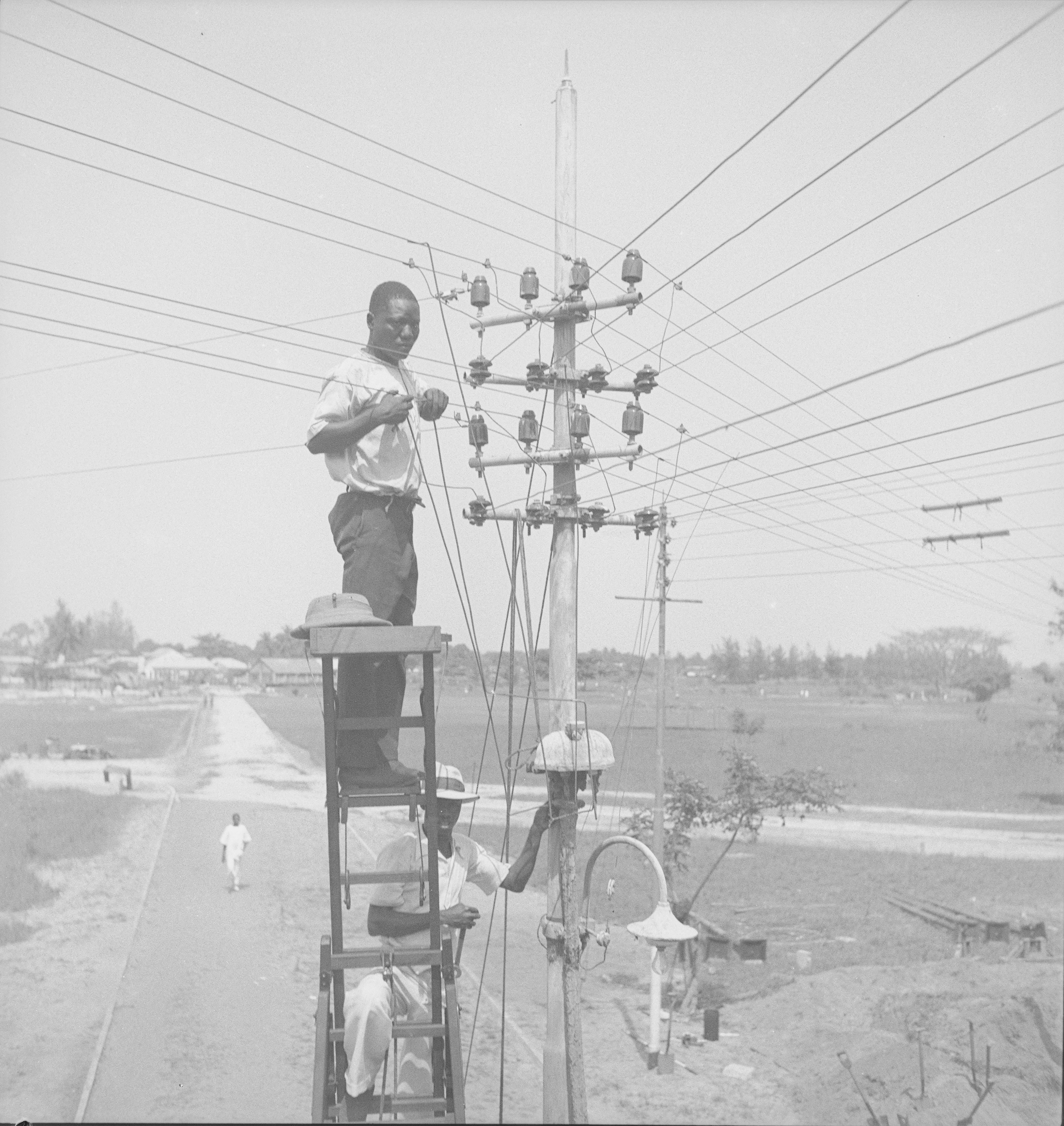
Men on a ladder, working on intersecting telegraph, telephone or power lines; street and buildings in the background
Copyright © 2026 the Melville J. Herskovits Library of African Studies, Northwestern University Libraries. Courtesy of the Melville J. Herkovits Library of African Studies E. H. Duckworth Photograph Collection, Northwestern University Libraries
We asked Nnamdi a few questions:
How has this exhibition idea evolved within your research and through the McMaster network?
Nnamdi Nnake: My current research is focused on telecommunications development in Nigeria, which traces its origins to the introduction of the telegraph in the late-nineteenth century. But when compared with the Global North, the significance of telegraph networks in Africa is an under-studied area of academic and public scholarship, so it is a privilege to be engaged in developing a body of work that helps to address this gap. In Summer 2025, a colleague familiar with my scholarly interests and public works of history recommended that I curate an exhibition. The idea was captivating but thinking about how to execute it left me with more questions than answers. But that Fall, I met another scholar who had recently curated an exhibition on telegraphy in India and our ensuing exchange was a lightbulb moment.
This exhibition, Connected Histories: The Telegraph in Nigeria, uses a combination of actual telegraph artifacts and enlarged images to showcase telegraphic communications in colonial Nigeria from a variety of perspectives such as, public use, local innovation, and maintenance, as well as colonial aims and local resistance. Visitors will be immersed in telegraphy via a combination of physical and digital content, such as the simulation of real-life telegraph operations. I am really excited to see how this research and exhibition have come to life.
In my scholarship and research, I enjoy using multimedia like animations, audio, digital art, text, and videos to examine the historical, current and future sociopolitical entanglements of African societies with colonial-era technologies such as railways, telephones, and radio. My goal is to make history authentic, appealing and accessible to audiences while retaining scholarly rigour for current and future use. I have adopted this interdisciplinary and cross-medium approach for Connected Histories and hope the exhibition can engage the McMaster community and the wider public.
How does the exhibition relate to our local communities? For example, local African-Canadian organizations, McMaster students and faculty, and how are you and the museum planning to engage with the Mac community?
NN: Everyone has something to learn from the exhibition, even without direct links to Nigeria or Africa. The legacies of telegraphic communications for modern society are numerous. If you rely on telephones, television, radio, the internet, computers, trains, planes, digital banking, and quite literally, anything linked to telecommunications, the exhibition will offer opportunities to learn about the origins of many technologies individuals and societies depend on today.
More specifically, the exhibition will be useful to McMaster’s academic and research community. In addition to public education, the project outputs include a newly published peer-reviewed essay in Technology and Culture, a globally renowned academic journal and flagship publication of the Society for the History of Technology, as well as an academic seminar presentation. My dream is that thesis-based exhibitions are formalized into an annual competition or systematic pathway for graduate students to develop and further their research. This would deepen institutional collaborations between academic departments at McMaster University and the M(M)A. The exhibition will also collaborate with the University’s ARiEAL Project, which is developing cutting edge visual wearables. So, this exhibition is not only history, but also interdisciplinary fusion of humanities, art, and technology research is quite amazing to be part of.
Within McMaster, the exhibition will also be useful for undergraduate courses in history, media and communications, or science and technology studies in Fall 2026. For example, students can be invited to conduct visual or other analysis of the exhibits within prescribed learning frameworks and produce academic reports or reflections that are evaluated as a portion of course requirements.
Finally, I am working with the M(M)A to promote the exhibition with the wider heritage community in Hamilton and the GTA, as well as to African Canadian students and other groups. Because it has digital elements, people can also enjoy Connected Histories from all over the world.
What is one work that you have a personal connection with? Why?
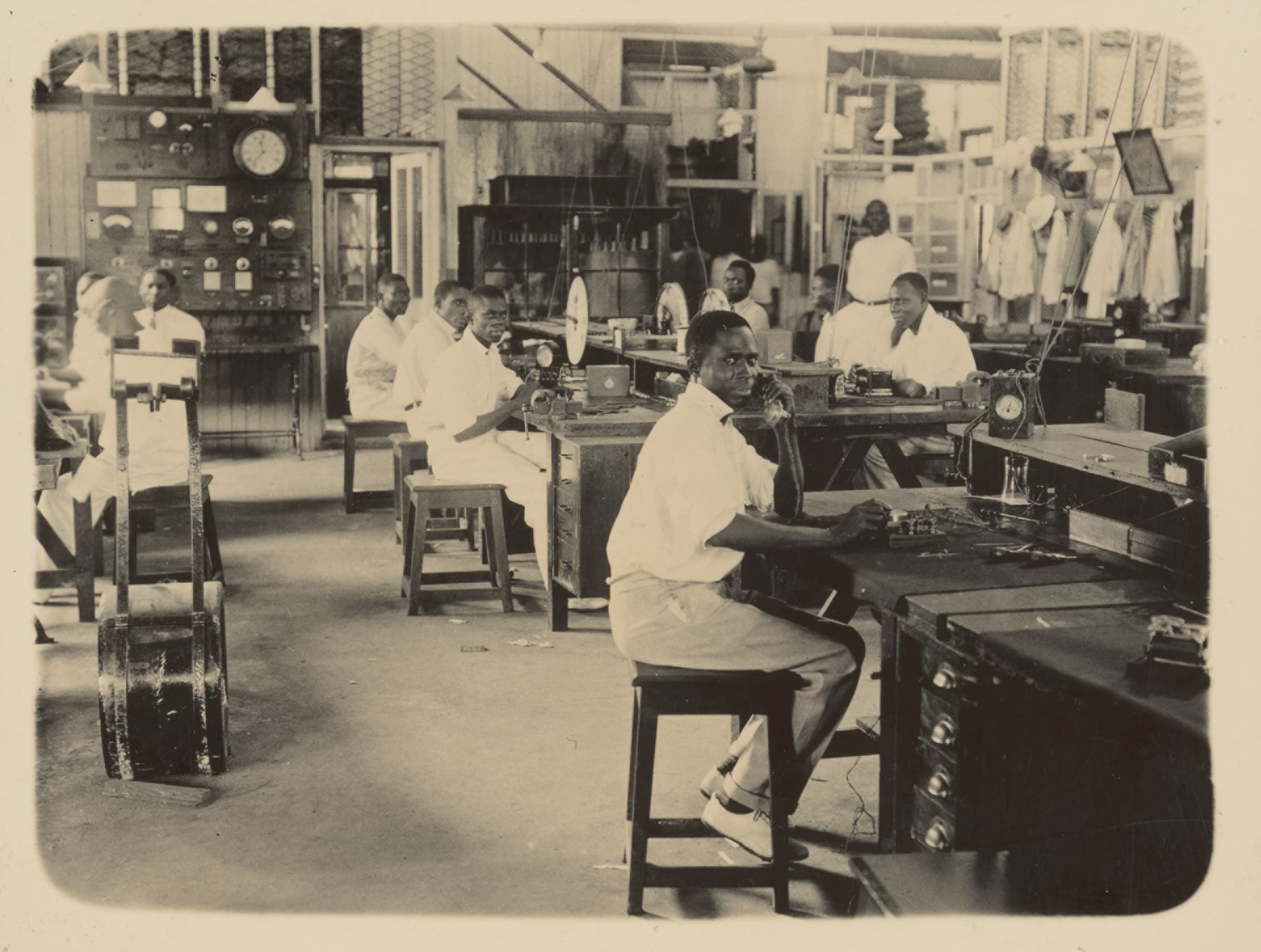
NN: Every work curated for this exhibition has special meaning for my research. The more I study them, the more I learn about telegraph technology and the local people who made it possible. Perhaps, I am a little partial to the scene of Mechanicians in the Posts and Telegraphs Workshop at Ebute Metta.
The men in the image exude professionalism and confidence in their knowledge and competence for the tasking work of maintenance and repairs that kept the network operational. Yet, these men are part of a largely unnamed but critical colonial workforce of technical professionals. This is an image I find striking for because it represents both presence and absence, which is an apt metaphor for the status of public and scholarly works on the telegraph in Nigeria.
Speaking to the artifact loans from Ingenium and Northwestern Libraries, how do they complement the museum’s permanent collection and add to the museum and the exhibition?
NN: The artifacts from our collaborating institutions and the M(M)A’s permanent collection complement one another well. Themes such as altered landscapes and the environmental impact of technological infrastructure permeate throughout both collections. I am excited that the permanent collection will also be on display. This cross-collection collaboration lends itself naturally to interdisciplinary approaches for curatorial and research work, as symbolizing how the whole is greater than the sum of the two collections. The institutional collaboration that this project has engendered also underscores the M(M)A’s mission as a leading art museum.
Nnake expressed his deepest gratitude for “the network of knowledge systems and researchers that have enriched and enabled the project.” He also acknowledged the invaluable institutional support provided by Northwestern University Libraries and Ingenium – Canada’s Museums of Science and Innovation. In particular, Nnake extended thanks to Professors Bonny Ibhawoh, Megan Armstrong, and Juanita De Barros of McMaster University’s History Department, as well as Mary Reid, Director and Chief Curator of the McMaster Museum of Art, whose equal partnership was instrumental in shaping and bringing the project to life.

Art as the Fifth Pillar of Health: Patricia Bovey to Deliver Keynote Lecture
September 17, 2026

Fall 2026 Exhibitions at the McMaster Museum of Art
September 4, 2026
Connected Histories, Research, and Archives—Interview with Nnamdi Nnake
September 1, 2026
What stories can the telegraph tell? More than a century after telegraph lines began to stretch across Nigeria, Connected Histories: The Telegraph in Nigeria invites visitors to take a fresh look at a technology that helped shape modern communications, colonial governance, labour, and everyday life. Drawing on the doctoral research of McMaster University PhD candidate Nnamdi Nnake, the exhibition brings together rare artifacts, archival […]