Art of Awareness – Susan Detwiler
February 19, 2015
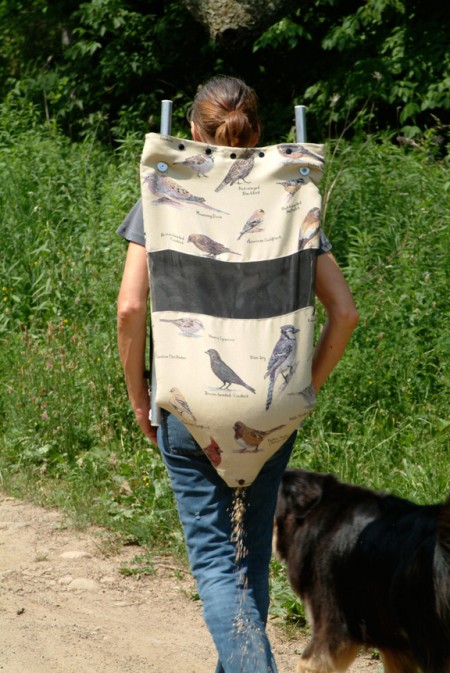
Currently on display is a long-term installation of Canadian artist Susan Detwiler’s 2005 performance object Seed Pack. The work was previously shown at the McMaster Museum of Art in 2008 as part of Detwiler’s solo exhibition Feral.
In the exhibition catalogue, Detwiler writes about her intimate relationship with nature, and the importance of her daily, early morning walks where she “catches rush hour in the bush”.
Her acculturation to the wild is emphasized in her writing, “I make a mental note to switch to wide-angle vision, moving from Beta into Alpha, merging with my surroundings.” Beta and Alpha here refer to brain waves; Alpha waves are connected with a relaxed mental state and Beta is associated with normal wakeful consciousness. (http://www.finerminds.com/mind-power/brain-waves/) Alpha waves affect cognition by acting as a filter to help us sort out irrelevant sensory input to our brains.
We use these rhythms every day.
“Imagine the simple task of backing a car out of the driveway. In order to reach the street safely, you must hold your destination in mind while steering and ignoring distractions from every modality: news on the radio, children playing at the end of the block, an itch on your foot, the glare of the sun in your eyes. Most people filter out these distractions subconsciously — but should irrelevant stimuli distract you, backing out can become a difficult ordeal.” (http://blog.lumosity.com/meditation2)
When Detwiler refers to “moving from Beta into Alpha”, she’s mindfully moving into a cognitive state where she is more relaxed and meditative upon her walking. And the act of walking itself supports these types of brain waves, as moving into Alpha can be achieved through performing tasks you enjoy and/or make you feel peaceful.
Susie Major: What exactly is the natural world that you see yourself wanting to participate in?
Susan Detwiler: I think it has partially something to do with wanting to cultivate or re-cultivate certain ways of being, or ways of observing things, that I think we may have lost by stepping outside of the wild.
Interview excerpt from Susan Detwiler: Hindsight (Esplanade Art Gallery, Medicine Hat, and the Thames Art Gallery, Chatham) 2003.
– Teresa Gregorio, McMaster Museum of Art

Art as the Fifth Pillar of Health: Patricia Bovey to Deliver Keynote Lecture
September 17, 2026
Fall 2026 Exhibitions at the McMaster Museum of Art
September 4, 2026
Connected Histories, Research, and Archives—Interview with Nnamdi Nnake
September 1, 2026
What stories can the telegraph tell? More than a century after telegraph lines began to stretch across Nigeria, Connected Histories: The Telegraph in Nigeria invites visitors to take a fresh look at a technology that helped shape modern communications, colonial governance, labour, and everyday life. Drawing on the doctoral research of McMaster University PhD candidate Nnamdi Nnake, the exhibition brings together rare artifacts, archival […]